

Iron powder toroids, as crucial components of inductors and magnetic elements, are widely used in various electronic and power electronics fields. Their unique material properties and structural design enable them to excel in filtering, energy storage, and electromagnetic interference (EMI) suppression.
Iron powder toroids are primarily composed of a mixture of iron powder and insulating materials, pressed to form a ring-shaped magnetic core with a specific permeability. The iron powder undergoes a special processing technique, ensuring uniform particle size and surface insulation, which effectively reduces eddy current losses inside the core. The toroidal structure of the magnetic ring allows for even distribution of the magnetic field, reducing magnetic flux leakage and improving the performance and stability of inductors.
The permeability of the iron powder core is between that of pure iron cores and air cores, providing excellent nonlinear magnetic properties. This enables iron powder toroids to handle larger DC bias currents without easily saturating, making them especially advantageous in high-frequency and high-current applications.
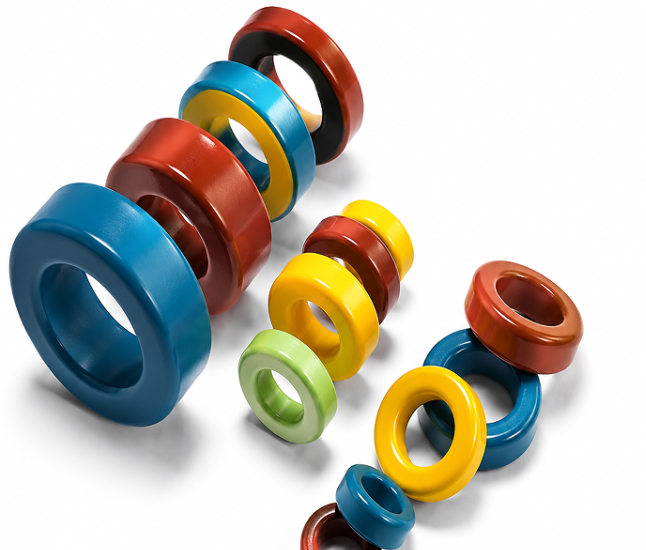
Iron powder toroids store energy in the inductor by magnetizing the iron powder material. When current flows through the winding, it generates a magnetic field, which induces magnetic flux in the core material. Due to the tiny gaps between the iron powder particles, the magnetic core has a relatively high resistivity, effectively reducing eddy current losses and allowing the iron powder inductor to operate stably at higher frequencies.
Additionally, the moderate permeability of the iron powder core allows for effective control of the inductance Q-factor and current-carrying capacity, ensuring that the inductor has good filtering effects and stable current handling in circuits.
Iron powder toroids, with their unique material structure and excellent electromagnetic characteristics, play an indispensable role in modern electronic and power electronic devices. As electronic technology continues to evolve, iron powder toroids will continue to play a key role in improving circuit performance, reducing electromagnetic interference, and enhancing system stability, driving the development of more efficient and reliable electronic products.
Iron powder toroids and ferrite toroids are both widely used magnetic cores, but they have different magnetic characteristics and are suitable for different circuit requirements. Choosing the right core material depends on factors such as operating frequency, current level, energy storage requirements and application conditions.
The main difference between these two materials is their magnetic structure and performance under operating conditions.
Iron powder toroids feature a distributed air gap within the magnetic material. This structure helps the core maintain stable inductance under high DC current conditions and improves resistance to saturation.
Ferrite toroids generally provide higher permeability options and lower core loss at higher frequencies, making them commonly used in transformer and high-frequency applications.
For power applications where continuous DC current is present, DC bias performance is an important consideration. Iron powder toroids usually maintain better inductance stability under high current because the distributed air gap reduces the risk of magnetic saturation.
This makes iron powder cores suitable for applications such as power inductors, DC-DC converters and energy storage components.
| Core Type | Common Applications |
|---|---|
| Iron Powder Toroid | Power inductors, DC-DC converters, output chokes, energy storage applications |
| Ferrite Toroid | Transformers, high-frequency circuits, EMI suppression applications |
The choice between iron powder and ferrite toroids should be based on the actual electrical requirements rather than simply selecting the material with higher permeability. Engineers should evaluate frequency, current, power loss and operating conditions before making a decision.
Selecting the right iron powder toroid requires evaluating both electrical performance and mechanical requirements. A suitable toroid core should provide stable inductance, sufficient current handling capability and reliable operation under expected working conditions.
The required inductance value is one of the most important factors when selecting an iron powder toroid. It affects core size, winding turns and overall inductor design.
Engineers should consider the target inductance value together with operating frequency and current conditions to determine the appropriate core specification.
For power applications, the core must maintain stable performance under continuous current. Important factors include:
Maximum DC current
Saturation characteristics
Temperature rise during operation
Required power handling capability
A properly selected iron powder toroid helps prevent excessive inductance loss when the magnetic core operates under high current conditions.
Frequency has a significant influence on magnetic core performance. Engineers should evaluate core loss, efficiency requirements and operating frequency range when selecting an iron powder toroid.
A core material suitable for low-frequency power applications may not provide the same performance in higher-frequency circuits.
The physical dimensions of the toroid core should match the available installation space and winding requirements. Important dimensions include:
Outer diameter (OD)
Inner diameter (ID)
Height
Available winding area
Proper size selection ensures sufficient electrical performance while maintaining compatibility with the final assembly.
Environmental conditions should also be considered during selection, including operating temperature, cooling conditions and continuous load requirements.
For customized magnetic components, engineers can work with manufacturers to evaluate material selection, core dimensions and electrical requirements to achieve the desired performance.



 English